MCP use cases
Four conversations built from the pkinative-mcp examples and prompts: triaging a failing TLS chain, issuing a test certificate, checking revocation offline, and opening keys without leaking a byte.
pkinative-mcp 1.0.0 ships an examples/ directory of executable tool calls that its test suite runs against the server, and seven prompts, five of which are PKI recipes naming the tools in order. Each case below follows one prompt, with the calls taken from those examples. The examples address the test PKI as fixtures/… inside the sandbox (PKINATIVE_MCP_OUTPUT_DIR), where their runner copies it; test-only-password is that PKI's published password. Every payload is a tools/call request's params, every result was printed by the 1.0.0 server, and the tools and their inputs are documented in the MCP guide.
Case 1 — An agent triages a failing TLS chain #
A user pastes a server certificate and says their TLS client rejects it. The verify_before_trust prompt gives the agent the order: describe the certificate, then ask for the verdict at a pinned instant, then bring revocation evidence — and branch on reasons[].code, never on message text.
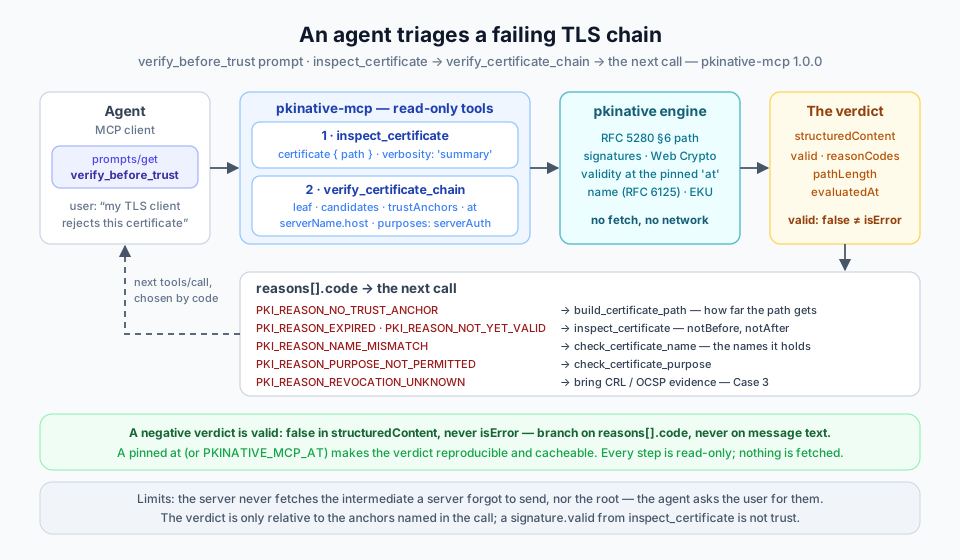
Describe first (examples/inspect-certificate-summary.json):
{ "name": "inspect_certificate", "arguments": { "certificate": { "path": "fixtures/leaf.crt.pem" }, "verbosity": "summary" } }
{"serialNumberHex":"1001","subjectString":"CN=example.test,O=pkinative-cli test,C=FR","issuerString":"CN=Test Intermediate CA,O=pkinative-cli test,C=FR","notBefore":"2026-01-01T00:00:00.000Z","notAfter":"2046-01-01T00:00:00.000Z","publicKey":"ec","extensionKinds":["basicConstraints","keyUsage","extendedKeyUsage","subjectAltName","subjectKeyIdentifier","authorityKeyIdentifier","crlDistributionPoints","authorityInfoAccess"],"selfIssued":false,"diagnosticCount":0}
Then the verdict (examples/verify-certificate-chain-server.json) — the leaf, the intermediates the server sent as candidates, the roots the client trusts, the host and the purpose:
{ "name": "verify_certificate_chain", "arguments": { "leaf": { "path": "fixtures/leaf.crt.pem" }, "candidates": [{ "path": "fixtures/inter.crt.pem" }], "trustAnchors": [{ "path": "fixtures/root.crt.pem" }], "at": "2027-01-01T00:00:00Z", "serverName": { "host": "a.wild.example.test" }, "purposes": ["serverAuth"], "verbosity": "summary" } }
{"valid":true,"reasonCodes":[],"pathLength":3,"evaluatedAt":"2027-01-01T00:00:00.000Z","revocationEvidence":{"crls":0,"ocspResponses":0,"required":false},"diagnosticCount":0}
When the client rejects it, the same call answers why, and each reason code sends the agent to its next call. A negative verdict is valid: false in structuredContent, never isError:
reasonCodes |
What it means | Next call |
|---|---|---|
PKI_REASON_NO_TRUST_ANCHOR |
No path reaches the anchors: the server did not send its intermediate, or the client trusts another root. The same call without candidates answers ["PKI_REASON_SIGNATURE_NOT_CHECKED","PKI_REASON_NO_TRUST_ANCHOR"] with pathLength: 1 |
build_certificate_path, to see how far the path gets (examples/build-certificate-path-no-anchor.json: found: false, structuralReasons PKI_REASON_NO_TRUST_ANCHOR) |
PKI_REASON_EXPIRED, PKI_REASON_NOT_YET_VALID |
A certificate of the path is outside its validity at at (examples/verify-certificate-chain-expired.json, with at 2050-01-01, answers one PKI_REASON_EXPIRED per certificate) |
inspect_certificate on each, for notBefore and notAfter |
PKI_REASON_NAME_MISMATCH |
The chain is sound and the certificate is for another host | check_certificate_name, whose reason lists the names the certificate holds |
PKI_REASON_PURPOSE_NOT_PERMITTED |
The certificate, or a CA above it, does not allow serverAuth |
check_certificate_purpose |
PKI_REASON_REVOCATION_UNKNOWN |
requireRevocation was asked and no evidence covers the leaf |
Case 3 |
The name check (examples/check-certificate-name-mismatch.json):
{ "name": "check_certificate_name", "arguments": { "certificate": { "path": "fixtures/leaf.crt.der" }, "host": "evil.test" } }
{"form":"certificate","valid":false,"reasons":[{"code":"PKI_REASON_NAME_MISMATCH","message":"the certificate does not name the DNS name \"evil.test\": it names \"example.test\", \"*.wild.example.test\", 192.0.2.1. A chain that verifies still says nothing about which host the certificate is for","standard":"RFC 6125 §6","path":"certificate.subjectAltName"}],"reference":{"kind":"dns","value":"evil.test"},"subject":"CN=example.test,O=pkinative-cli test,C=FR","diagnostics":[],"diagnosticCounts":{}}
Why pin at. A verdict depends on the instant. A pinned at — or the operator's PKINATIVE_MCP_AT — makes it reproducible and cacheable; an omitted one is the wall clock, reported in evaluatedAtSource, and never cached. Limits: the server never fetches the intermediate a server forgot to send, nor the root: the agent asks the user for them, and the verdict is only ever relative to the anchors named in the call. A signature.valid from inspect_certificate is one signature against one key, not trust.
Case 2 — Issuing a test certificate #
A developer needs a CA and a TLS server certificate for an integration test, from keys they already have. The issue_certificate prompt chains four calls — the CA, the request, the leaf, then the chain that proves them; the server generates no key and exports none, and each artefact is verified before its bytes are returned. The first three below are examples/create-certificate-self-signed-ca.json, examples/create-csr-round-trip.json and examples/create-certificate-issue-leaf.json, written into the sandbox with outputMode: 'file' and chained as the prompt describes — the leaf issued by the new CA — so no artefact travels back through the model's context; the fourth is the prompt's last step.
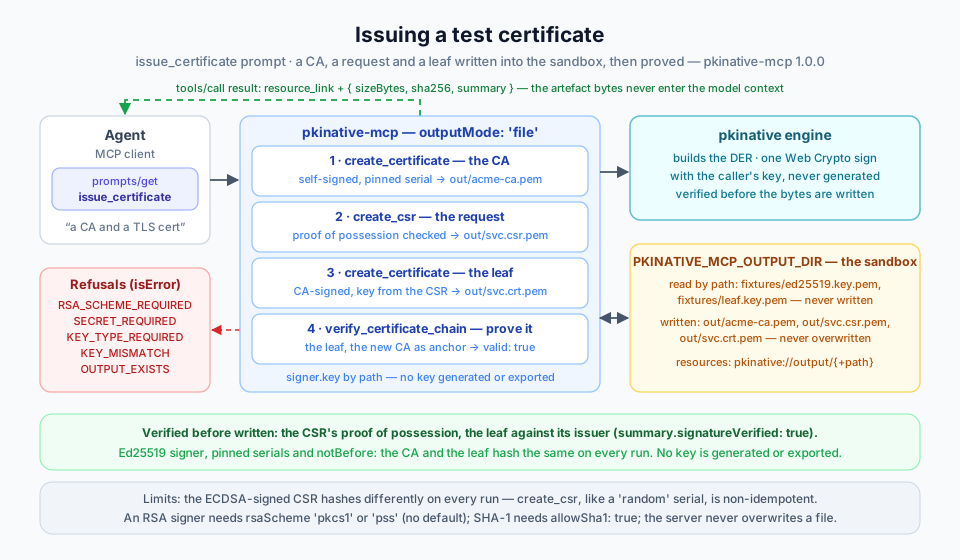
The CA, self-signed because no issuerCertificate is given; serial and notBefore are pinned, so its bytes are reproducible:
{ "name": "create_certificate", "arguments": { "spec": { "serialNumber": 1, "subject": { "C": "FR", "O": "Acme", "CN": "Acme Test CA" }, "notBefore": "2027-01-01T00:00:00Z", "validityDays": 3650, "extensions": { "basicConstraints": { "ca": true, "pathLen": 0 }, "keyUsage": ["keyCertSign", "cRLSign"] } }, "signer": { "key": { "path": "fixtures/ed25519.key.pem" } }, "outputMode": "file", "outputPath": "out/acme-ca.pem", "encoding": "pem" } }
The result carries a resource_link to pkinative://output/out/acme-ca.pem and, in structuredContent, the size, the SHA-256 of the DER, the absolute filePath written and a summary (filePath elided below):
{"encoding":"pem","sizeBytes":350,"sha256":"694fa39766a751eaaf6be471061639f5b3bdce183549d0a15272fbca5e79e0b8","mode":"file","summary":{"serialNumber":"01","randomSerial":false,"subject":"CN=Acme Test CA,O=Acme,C=FR","issuer":"CN=Acme Test CA,O=Acme,C=FR","selfSigned":true,"signatureAlgorithm":{"oid":"1.3.101.112","name":"Ed25519","hasParameters":false},"notBefore":"2027-01-01T00:00:00.000Z","notAfter":"2036-12-29T00:00:00.000Z","notBeforeSource":"input","extensions":["basicConstraints","keyUsage","subjectKeyIdentifier"],"signatureVerified":true,"publicKeyFrom":"signer"},"diagnostics":[],"diagnosticCounts":{}}
The request, on the subject's side; the proof of possession is verified before the bytes return:
{ "name": "create_csr", "arguments": { "spec": { "subject": { "C": "FR", "O": "Acme", "CN": "svc.example.test" }, "extensions": { "subjectAltName": { "dns": ["svc.example.test", "www.svc.example.test"] }, "keyUsage": ["digitalSignature"], "extendedKeyUsage": ["serverAuth"] } }, "signer": { "key": { "path": "fixtures/leaf.key.pem" } }, "outputMode": "file", "outputPath": "out/svc.csr.pem", "encoding": "pem" } }
The leaf, its public key taken from the request, signed by the CA's key; the authorityKeyIdentifier is added, and the certificate is verified against the issuer before it is written (summary.signatureVerified: true, publicKeyFrom: "csr"):
{ "name": "create_certificate", "arguments": { "spec": { "serialNumber": "0x1a2b3c", "subject": { "C": "FR", "O": "Acme", "CN": "svc.example.test" }, "notBefore": "2027-01-01T00:00:00Z", "validityDays": 90, "extensions": { "subjectAltName": { "dns": ["svc.example.test", "www.svc.example.test"] }, "extendedKeyUsage": ["serverAuth"], "keyUsage": ["digitalSignature"] } }, "issuerCertificate": { "path": "out/acme-ca.pem" }, "subjectPublicKey": { "path": "out/svc.csr.pem" }, "signer": { "key": { "path": "fixtures/ed25519.key.pem" } }, "outputMode": "file", "outputPath": "out/svc.crt.pem", "encoding": "pem" } }
Prove it, as the prompt's last step asks — the leaf against the new CA, for its host and purpose:
{ "name": "verify_certificate_chain", "arguments": { "leaf": { "path": "out/svc.crt.pem" }, "trustAnchors": [{ "path": "out/acme-ca.pem" }], "at": "2027-02-01T00:00:00Z", "serverName": { "host": "www.svc.example.test" }, "purposes": ["serverAuth"], "verbosity": "summary" } }
{"valid":true,"reasonCodes":[],"pathLength":2,"evaluatedAt":"2027-02-01T00:00:00.000Z","revocationEvidence":{"crls":0,"ocspResponses":0,"required":false},"diagnosticCount":0}
What is reproducible. The CA and the leaf are signed with Ed25519 and have pinned serials and dates: run again, they hash the same. The request is signed with an ECDSA key, whose signatures are randomised, so its SHA-256 changes on every run — which is why create_csr, like create_certificate with its default 'random' serial, is annotated as producing a non-idempotent artefact. Refusals the agent meets: an RSA signer without rsaScheme is RSA_SCHEME_REQUIRED (data.remedy: rsaScheme:'pkcs1'|'pss'); an encrypted key without a password is SECRET_REQUIRED, without a type KEY_TYPE_REQUIRED; a key that does not belong to the issuer is KEY_MISMATCH; an outputPath that already exists is OUTPUT_EXISTS — the server never overwrites. SHA-1 needs allowSha1: true.
Case 3 — Offline revocation #
An agent working on an air-gapped or egress-restricted host is asked whether a certificate has been revoked. The server has no network code path; the offline_revocation prompt tells the agent where the evidence comes from and which tool judges it.
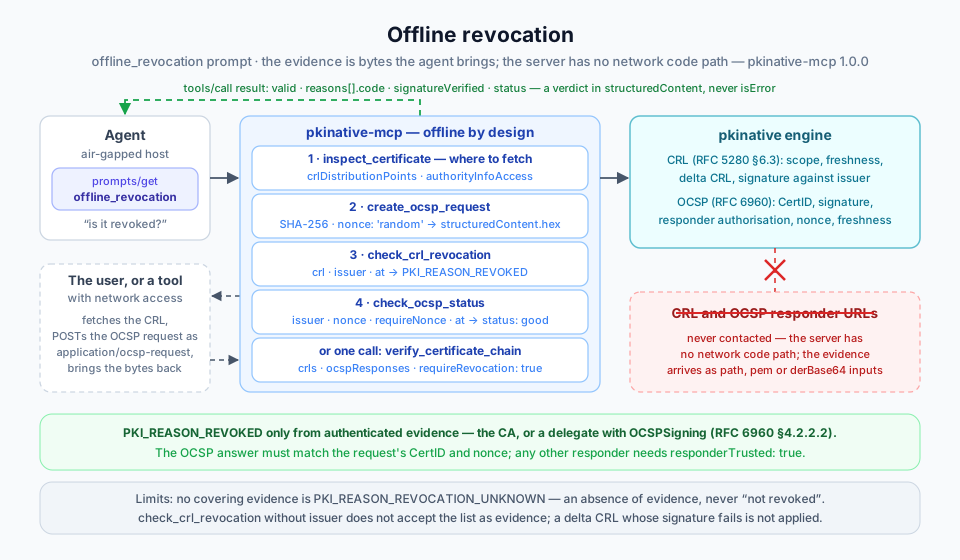
Where to fetch. inspect_certificate lists the crlDistributionPoints and authorityInfoAccess extensions — the CRL and OCSP responder URLs. The user, or another tool with network access, fetches the CRL; for OCSP, the server builds the request to send (examples/create-ocsp-request.json):
{ "name": "create_ocsp_request", "arguments": { "certificate": { "path": "fixtures/leaf.crt.pem" }, "issuer": { "path": "fixtures/inter.crt.pem" }, "hashAlgorithm": "SHA-256", "nonce": "random", "encoding": "hex" } }
The request's bytes land in structuredContent.hex, POSTed by the user as application/ocsp-request; the summary keeps what the answer must match:
{"certIdHex":"3057300d0609608648016503040201050004206445323505d6fdd731e1330cfe6724f37cef7f6086d287b50353561b96e64e1904201c0b32ab5ee79c8e1de725b94e5ef34ce779d13fef4d97c290fe5931cc4c47c402021001","hashAlgorithm":"SHA-256","nonceHex":"1dc290a3e07935fff3bae7572d4101bb","randomNonce":true,"certIdOnly":false,"serialNumber":"1001","subject":"CN=example.test,O=pkinative-cli test,C=FR","issuer":"CN=Test Intermediate CA,O=pkinative-cli test,C=FR","sizeBytes":136}
Judge the CRL (examples/check-crl-revocation.json, second step) — scope, freshness, the signature against issuer, the serial:
{ "name": "check_crl_revocation", "arguments": { "certificate": { "path": "fixtures/revoked.crt.pem" }, "crl": { "path": "fixtures/inter.crl.der" }, "issuer": { "path": "fixtures/inter.crt.pem" }, "at": "2027-01-01T00:00:00Z", "fields": ["valid", "reasons.code", "signatureVerified", "crlNumber"] } }
{"valid":false,"reasons":[{"code":"PKI_REASON_REVOKED"}],"signatureVerified":true,"crlNumber":"1"}
Judge the OCSP response (examples/check-ocsp-status.json) — the CertID recomputed from issuer, the signature, the responder's authorisation, freshness, and the nonce the request carried:
{ "name": "check_ocsp_status", "arguments": { "response": { "path": "fixtures/leaf.ocsp.der" }, "certificate": { "path": "fixtures/leaf.crt.pem" }, "issuer": { "path": "fixtures/inter.crt.pem" }, "nonce": "1538349c433373ed058c291909df5b3e", "requireNonce": true, "at": "2027-01-01T00:00:00Z", "verbosity": "summary" } }
{"valid":true,"reasonCodes":[],"status":"good","signatureVerified":true,"responderAuthorized":true,"responder":"CN=Test OCSP Responder,O=pkinative-cli test,C=FR","evaluatedAt":"2027-01-01T00:00:00.000Z","diagnosticCount":0}
The responder here is a delegate the intermediate issued with the OCSPSigning purpose, embedded in the response; the server accepts the CA itself or such a delegate (RFC 6960 §4.2.2.2), and any other signer only with responderTrusted: true.
Or in one call (examples/verify-certificate-chain-revoked.json): the chain verdict with the evidence attached and requireRevocation, which demands evidence for the end-entity certificate:
{ "name": "verify_certificate_chain", "arguments": { "leaf": { "path": "fixtures/revoked.crt.pem" }, "candidates": [{ "path": "fixtures/inter.crt.pem" }], "trustAnchors": [{ "path": "fixtures/root.crt.pem" }], "crls": [{ "path": "fixtures/inter.crl.pem" }], "ocspResponses": [{ "path": "fixtures/revoked.ocsp.der" }], "requireRevocation": true, "at": "2027-01-01T00:00:00Z", "fields": ["valid", "reasons.code", "revocationEvidence", "pathLength"] } }
{"valid":false,"reasons":[{"code":"PKI_REASON_REVOKED"},{"code":"PKI_REASON_REVOKED"}],"revocationEvidence":{"crls":1,"ocspResponses":1,"required":true},"pathLength":3}
Limits. PKI_REASON_REVOKED is reported only from authenticated evidence; with none covering a certificate, the reason is PKI_REASON_REVOCATION_UNKNOWN — an absence of evidence, never "not revoked". check_crl_revocation without issuer does not accept the list as evidence, and a delta CRL whose signature does not verify is not applied.
Case 4 — Opening keys safely #
A user hands the agent a .p12 and an encrypted key from an old export and asks what they hold. The open_keys_safely prompt says: describe before opening, open without exporting, and keep the password out of the transcript where possible.
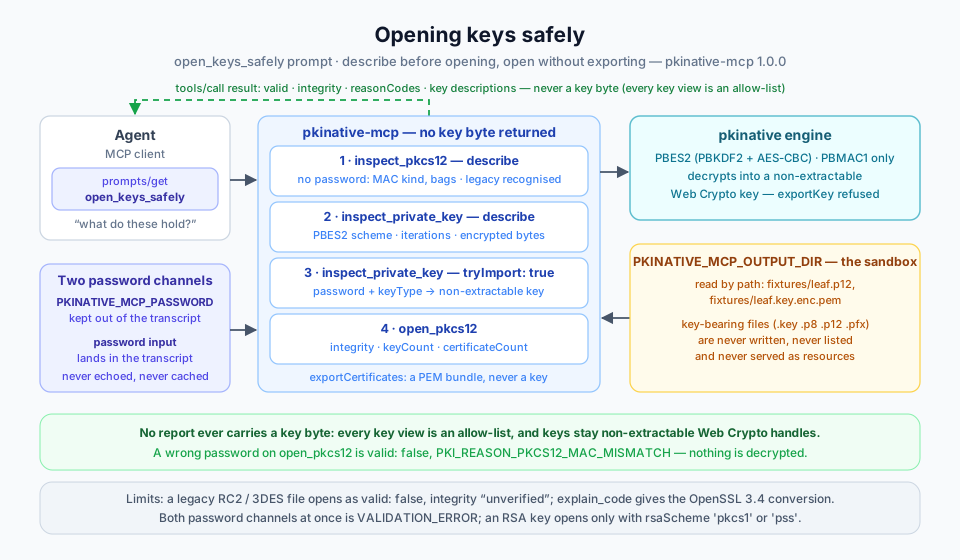
Describe without a password (examples/inspect-pkcs12-describe.json, examples/inspect-private-key-describe.json). PKINATIVE_MCP_PASSWORD counts as the password of every password-accepting tool, so describing a file without one needs it unset:
{ "name": "inspect_pkcs12", "arguments": { "pkcs12": { "path": "fixtures/leaf.p12" }, "verbosity": "summary" } }
{"version":3,"macKind":"pbmac1","contentCount":2,"bagCount":1,"bagKinds":["pkcs8ShroudedKeyBag"],"diagnosticCount":0}
{ "name": "inspect_private_key", "arguments": { "key": { "path": "fixtures/leaf.key.enc.pem" } } }
The key report names the scheme — PBES2 (PBKDF2 with HMAC-SHA-256, AES-256-CBC), 2048 PBKDF2 iterations, 144 encrypted bytes — and neither its kind nor its curve, which an encrypted PKCS#8 key reveals only once decrypted. A legacy file is recognised before anyone types a password (examples/inspect-pkcs12-legacy.json):
{ "name": "inspect_pkcs12", "arguments": { "pkcs12": { "path": "fixtures/legacy.p12" }, "fields": ["mac.kind", "contents.path", "contents.encryption.scheme"] } }
{"mac":{"kind":"pkcs12-kdf"},"contents":[{"path":"authSafe[0]","encryption":{"scheme":"pbeWithSHAAnd40BitRC2-CBC"}},{"path":"authSafe[1]"}]}
Open (examples/inspect-private-key-import.json, and examples/open-pkcs12-file.json inline): the key is decrypted straight into a non-extractable Web Crypto key, described and never exported:
{ "name": "inspect_private_key", "arguments": { "key": { "path": "fixtures/leaf.key.enc.pem" }, "tryImport": true, "password": "test-only-password", "keyType": "ec-p256", "fields": ["imported", "encryption.scheme"] } }
{"imported":{"ok":true,"encrypted":true,"algorithm":{"name":"ECDSA","hash":"SHA-256","namedCurve":"P-256"},"key":{"type":"private","algorithm":"ECDSA","extractable":false,"usages":["sign"]}},"encryption":{"scheme":"PBES2 (PBKDF2 with HMAC-SHA-256, AES-256-CBC)"}}
{ "name": "open_pkcs12", "arguments": { "pkcs12": { "path": "fixtures/leaf.p12" }, "password": "test-only-password", "exportCertificates": true, "verbosity": "summary" } }
{"valid":true,"integrity":"verified","reasonCodes":[],"keyCount":1,"certificateCount":2,"crlCount":0,"diagnosticCount":0}
exportCertificates: true attaches a PEM bundle of the certificates and CRLs — never a key — as an embedded resource, or as a sandbox file with outputMode: 'file'.
What goes wrong, and how it says so. Opening is a verdict, so most failures are valid: false with a reason, not isError:
| Situation | Result |
|---|---|
No password from either channel (examples/open-pkcs12-no-password.json) |
isError, SECRET_REQUIRED, before anything is read |
A wrong password on open_pkcs12 |
valid: false, integrity: "mismatch", PKI_REASON_PKCS12_MAC_MISMATCH — nothing is decrypted |
A wrong password on inspect_pkcs12 or inspect_private_key |
isError, PKI_CRYPTO_DECRYPTION_FAILED (data.errorClass: "password") |
| The legacy file opened | valid: false, integrity: "unverified", PKI_REASON_PKCS12_INTEGRITY_UNVERIFIED and PKI_REASON_PKCS12_ENCRYPTION_UNSUPPORTED; explain_code gives the OpenSSL 3.4 conversion |
An RSA key without rsaScheme (fixtures/rsa.p12) |
valid: false, PKI_REASON_PKCS12_RSA_SCHEME_UNSPECIFIED; with rsaScheme: "pkcs1" (examples/open-pkcs12-rsa.json) it opens |
Passwords. A password input lands in the host's transcript; PKINATIVE_MCP_PASSWORD, set in the server's environment by the operator, does not. Never both — that is VALIDATION_ERROR. A call carrying a password is never cached, and the value is never echoed, logged or served. Limits: key-bearing files (.key .p8 .p12 .pfx) in the sandbox may be named by any path input — no tool returns their key bytes — but are never written (a converted PKCS#12 comes from OpenSSL), never listed and never served as resources.
See also #
- MCP guide — every tool, prompt, variable and error code.
- CLI use cases — the same workflows from a shell or a CI job.
- Use cases — the library in applications.
- Errors, diagnostics and reasons — every
PKI_*code these cases return. - The server's examples, its AI agent guide and its agent contract.